Explanation
The frequency domain is a list of so-called spectrum lines, which represent how much a certain frequency is present. Take for example a perfect sine "beep" at 440 Hz. In the time domain, it looks like a wave. In the frequency domain, it is a single line.
Most humans are very good at identifying the frequency domain subconsciously: we can hear frequencies - i.e., high or low pitched noises - from vibrations that are registered by our ears. Computers, unfortunately, have no ears. This is why we need a frequency transformation.
Computers see signals as sequences of numbers, and can't just identify a pitch. First, they need to transform the signal into the frequency domain, when it becomes a new set of numbers, which is a neat list of all the pitches or frequencies in a signal.
The DFT is a way of transforming a time domain signal, such as data points from an audio sample, into a frequency domain spectrum. A Fourier transform is a mathematical formula, invented by Joseph Fourier. "Discrete" implies that the signal is not a function, e.g. sin(x), but a defined amount of numbers, e.g. {0.123, 0.234, 0.345, ...}.
A DFT is described mathematically as the following operation:
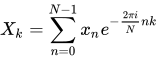
Here, Xk is the kth spectrum line, N is the data length, xn, and the other term in the sum expands through Euler's formula to a Nth root of unity. The result is a complex number, which represents how "present" the frequency at k is.
The DFT process is, in essence, a matrix multiplication. The columns would equate to the index n in the time domain, and the rows would equate to the index k in the frequency domain. The entries of this matrix are complex Nth roots of unity and may be described by polar coordinates.
Describing by polar coordinates has an interesting effect: because the entries are roots of unity, their modulus is always 1. This means we can describe the entires only by their angle.
And that is exactly what is visualized here: the angles of the complex entries of the DFT matrix.
And it looks reaaaally trippy.